Qi's Six Functions in Chinese Medicine: An Ancient Vocabulary for Human Physiology
By Shaun Menashe, LAc, MTOM, Dipl. O.M. | Golden Mean Acupuncture, Los Angeles
Few concepts in Chinese medicine generate more intrigue and confusion than qi (chee). The term has crossed into martial arts films, anime, popular spirituality, and the global wellness industry, where it often appears as a mysterious force that grants vitality, power, or special insight. For some, qi represents profound wisdom. For others, it is the word that confirms every suspicion that Chinese medicine is unscientific.
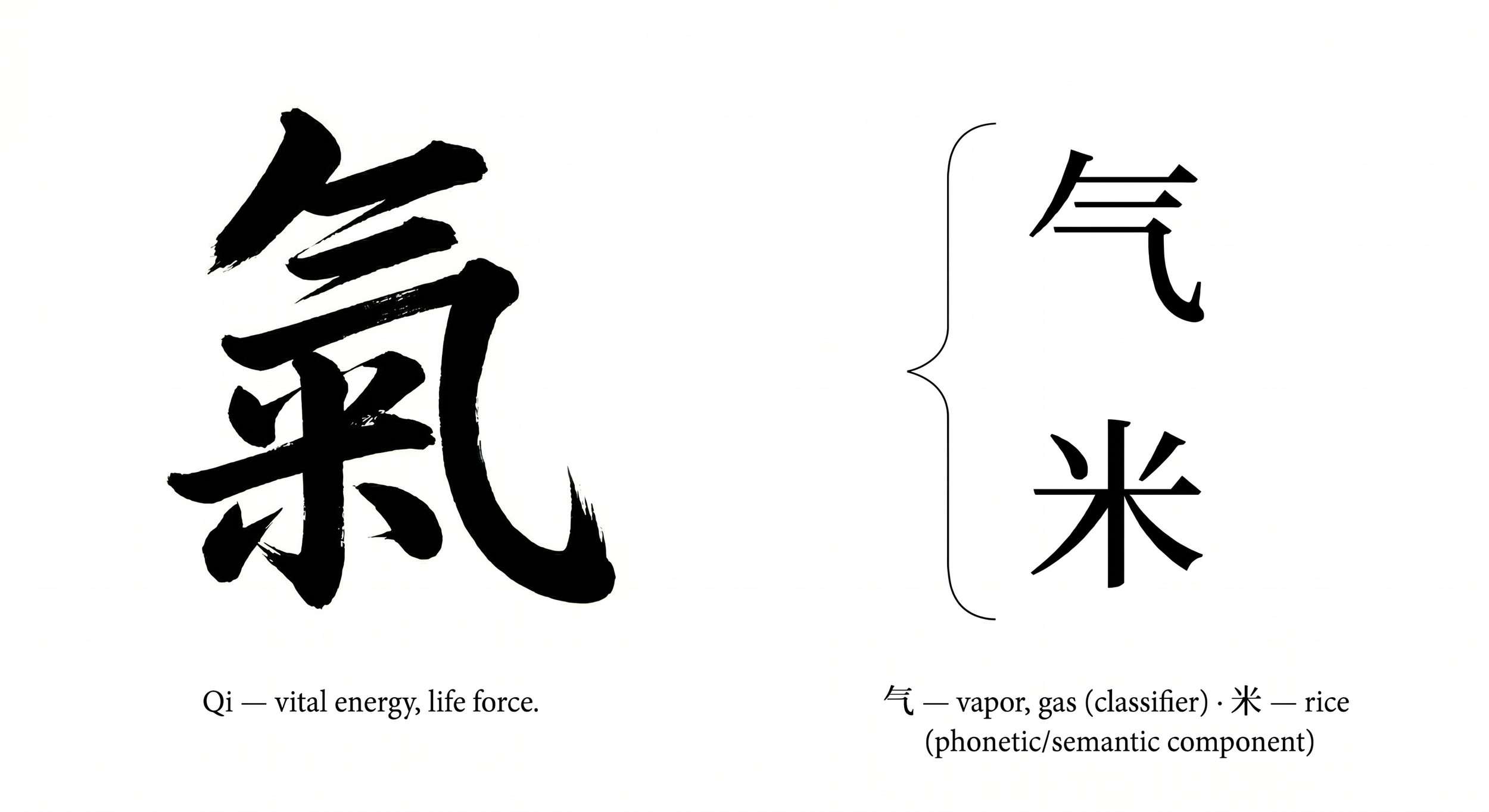
The classical character for qi (氣) depicts vapour rising from grain in the process of cooking. Rather than pointing to a specific substance, the image emphasizes transformation itself. This helps explain why no single English word fully captures qi. Classical writers used the term to describe a wide range of functional processes that modern language often separates into distinct categories.
The classical texts do not describe qi as a uniform phenomenon. While English tends to place these observations into separate categories, classical Chinese thought treated them as different aspects of a broader process held together by a single term. Depending on context, qi may refer to almost anything: weather, breath, emotion, movement, vitality, the activity of life itself, internal or external, coarse or subtle.
Classical Chinese physicians organized human physiology through functional relationships long before modern medicine could visualize cells, hormones, neurotransmitters, or immune signaling pathways. The question for researchers, patients, and providers alike is whether these functional categories, developed over thousands of years, still describe something real today. If these functional relationships do not hold up under scrutiny, Chinese medicine itself is false, as the bar for any functional claim is its efficacy. In examining the six functions of qi, we can see functional relationships and consider where they may or may not be present in modern physiology.
Key Takeaways
Qi is not a substance, it's a functional vocabulary: one animating principle expressed through six functions (promoting, warming, defending, transforming, containing, nourishing), each with a parallel in modern physiology.
Chinese medicine and modern physiology describe the same organism through different organizing principles, not different bodies. Translation between them doesn't erase what either tradition observed, but the claim only holds as long as the function itself does.
Chronic fatigue, brain fog, digestive complaints, dysautonomia, or persistent pain with normal test results often reflect disruptions in functional relationships, exactly the patterns Chinese medicine was built to identify and treat.
Wind and Aliveness: The Animating Principle
Long before the character for qi appeared in Chinese medical writing, the concept of wind already carried many qi-like qualities. Ancient oracle bone inscriptions from the Shang dynasty contain the character for wind (風, feng), depicting a force that arrived from heaven and brought transformation with it. Wind was associated with the stirring of dormant life, the movement of insects, the growth of vegetation, and the seasonal renewal of the natural world. Early forms of the character even incorporated the image of an insect, reflecting the belief that wind possessed the capacity to awaken living things into motion (Rochat de la Vallée, 2006).
This reveals an important intuition that would remain central to Chinese thought: life is recognized through movement, transformation, and responsiveness. A seed germinates. An insect emerges. A body rises, acts, adapts, and responds to its environment. Wind became a symbol for the invisible principle behind the visible expression of life.
When this idea entered Chinese medicine, it came to represent aliveness itself. Not a substance, but the ability of a living organism to maintain organization, respond to change, and sustain activity over time. Autonomic regulation, vascular tone, neurological responsiveness, and metabolic activity are the modern terms for these capacities. The vocabulary differs, but the underlying question is remarkably similar: what allows a living body to remain animated, responsive, and organized from moment to moment?
In both traditions, this aliveness is not a static property of tissue, but a continuous, dynamic state of relationship. It is the invisible background coordination that maintains physiological form. When this coordination falters, the breakdown is immediate and structural integrity alone cannot sustain the organism.
Consider the mechanics of syncope (fainting). The physical structures of the body are intact. Yet a transient failure of autonomic regulation causes an abrupt drop in systemic vascular tone. As cerebral blood flow falls, the body loses its relationship to gravity and collapses. Classical physicians understood this as qi at its most basic layer: not a substance, but the animating principle whose withdrawal, even briefly, unmade the organization it had been sustaining.
The Six Functions of Qi
The six functions below are its specific expressions in the living body, differentiated by location, substance, and clinical presentation. Each is a mode of the same underlying aliveness.
Promoting (推动)
The promoting function of qi drives growth and development, sustains the activity of the organ systems and meridians, moves blood through the vessels, and distributes fluid through the body's tissues. Where this function is robust, homeostatic processes are dynamic and physiological reserve is maintained. Where it is deficient, these processes slow, stagnate, or fail to initiate (Chinese Acupuncture and Moxibustion).
Modern physiology offers a parallel account in coordinated mechanisms across several systems: autonomic regulation of organ function and vascular tone, growth factors driving tissue repair, and the circulatory and lymphatic systems moving blood and fluid through the body (OpenStax Anatomy & Physiology 2e, Ch. 15.2 and Ch. 21; StatPearls, Physiology, Growth Factor, NBK442024). What classical medicine treated as one unified dynamic, modern physiology resolves into separate, named mechanisms.
Clinically, a failure of this function maps onto two distinct states in Chinese medicine: qi deficiency, representing sluggish or suboptimal function, and qi stagnation, representing the failure of movement itself. In contemporary practice these present as poor visceral motility (functional dyspepsia, or slow gastric emptying), microcirculatory insufficiency, lymphatic congestion, and functional pain conditions such as fibromyalgia and myofascial pain syndrome, characterized by widespread musculoskeletal pain and focal trigger points in the absence of identifiable structural lesion on standard imaging.
Warming (温煦)
Qi is said to "dominate warming" (Plain Questions, Chapter 22), maintaining normal body temperature, sustaining metabolic heat production, and readjusting thermal regulation in response to environmental conditions.
Modern physiology offers a parallel in mechanisms of thermoregulation and metabolic rate: the body's ability to generate and distribute heat, adjusted continuously to internal and external conditions. Basal metabolic rate determines the background heat generation that keeps the body at functional temperature (OpenStax Anatomy & Physiology 2e, Ch. 5.2; StatPearls, Physiology, Thyroid, NBK500006). Classical medicine named this activity the warming function.
Clinically, a failure of this function presents as cold intolerance, persistently cold hands and feet, and a cold-sensitive bowel pattern such as irritable bowel syndrome with diarrhea that worsens with cold exposure.
Defending (防御)
The defending function of qi protects the body against environmental pathogens and combats those threats once an illness has occurred (Plain Questions, Chapter 72). Wei qi in particular circulates at the exterior, forming the body's first line of resistance against infection and regulation of the body surface.
Classical sources call this the defending function. Modern immunology offers a parallel in innate and adaptive immunity, concentrated most heavily across the skin, the mucous membranes, and the gut, which houses the vast majority of the body's immune cells (OpenStax Anatomy & Physiology 2e, Ch. 21). Both models tie this defense to digestion: classical medicine through defensive qi drawn from refined essence, modern immunology through nutrient-dependent immune competence. Chronic stress depletes this capacity in both models; sustained stress hormone activation suppresses immune function and compromises the body's surface defenses (StatPearls, Physiology, Cortisol, NBK538239).
Clinically, a failure of this function presents as recurrent upper respiratory infections, frequent viral illness, and general susceptibility to infection.
Containing (固摄)
Qi contains and retains: it keeps blood within the vessels, regulates perspiration, controls urination, and prevents the inappropriate loss of substances. When this function is insufficient, the clinical result is hemorrhage, excessive sweating, urinary incontinence, prolapse, or other forms of unwanted leakage (Chinese Acupuncture and Moxibustion).
Modern physiology names these processes separately: coagulation, renal fluid retention, autonomic regulation of sweat glands, smooth muscle tone, and fascial integrity (OpenStax Anatomy & Physiology 2e, Ch. 18.5; StatPearls, Physiology, Antidiuretic Hormone, NBK537292). Each offers a possible modern parallel to what classical medicine grouped under one containing function.
Clinically, a failure of this function presents as pelvic organ prolapse, easy bruising and other coagulopathies, and menorrhagia, all of which warrant medical evaluation rather than assumption of a qi pattern alone.
Transforming (气化)
The transforming function of qi (qihua) describes the mutual conversion among essence, qi, blood, and body fluid, alongside the functional activity of the organ systems that makes these shifts possible. This includes the stomach processing food into usable substances and the bladder discharging urine as a product of fluid metabolism (Plain Questions, Chapters 5 and 8).
The pancreas and liver sit at the center of this process in western medicine, converting what the digestive system extracts into usable substances and clearing the rest (OpenStax Anatomy & Physiology 2e; StatPearls, Physiology, Pancreas, NBK459261).
Clinically, a failure of this function presents as malabsorption, insulin resistance and blood sugar dysregulation, and edema from impaired fluid metabolism.
Nourishing (营养)
The nourishing function is the primary activity of ying qi, the nutrient qi that circulates within the blood vessels and provides nourishment to every tissue in the body (Chinese Acupuncture and Moxibustion). In western medicine, insulin coordinates the movement of glucose, amino acids, and fatty acids to tissue throughout the body (StatPearls, Biochemistry, Insulin Metabolic Effects, NBK525983), while the gut-muscle axis links nutrient absorption to skeletal muscle maintenance (Li et al., 2022).
It is the most yin of the six functions, the sustaining rather than activating pole of qi activity. Clinically, a failure of this function presents as anemia, brittle hair and nails, and pallor, findings that should be worked up medically before being attributed to a qi pattern.
Qi Was Never Missing
Classical Chinese medicine was built to observe physiological processes as a whole, monitoring functional patterns as they shift over time, before dysfunction crosses into measurable disease. Qi does not necessarily need to be located. It is bodily vocabulary: how it moves, warms, defends, transforms, contains, and nourishes. The classical physicians were describing physiology itself from a different vantage point, in a different century, with different instruments.
Modern medicine independently describes that same interdependence. Although divided into specialties, organ systems, and increasingly detailed fields of study, no physiological process exists in isolation. The digestive system influences the immune system. The nervous system influences the cardiovascular system. Hormones alter metabolism, sleep, cognition, and recovery simultaneously. The divisions exist because they make an unimaginably complex organism easier to study, not because the body itself is divided that way.
A Note from the Author
Of late there has been great skepticism around scientific discovery. At the root of these trust issues is not necessarily the fault of science itself. The scientific method, in the purest sense, exists to doubt itself. It is a framework of constant change, observation, and reframing. In that sense, we have experience with science. We move through the world testing our ideas and trying to get things right just a little more than wrong. We do that by observing massive amounts of data, searching for common themes, and testing our ideas. This is the same for scientists of the ancient and modern world, and all humans.
There has been a steady drift across the twentieth and twenty-first centuries of science eclipsing philosophy's cultural authority. Physicists and biologists are increasingly treated as the sole arbiters of truth, while philosophy is sidelined and we often act as though data alone can replace the need for an interpretive framework. While science is remarkably efficient at gathering data, it is philosophy that helps us determine what to do with it. The real schism in our medical culture is not around the validity of science itself, but in how we implement its findings in the real world.
His Holiness the Dalai Lama has drawn a useful distinction in his own writing on science: what science investigates and finds to be false is one category, but what science simply has not found yet, consciousness being his own example, is a different matter entirely. Qi may very well sit in this second category. At the root of all discovery is keeping an open mind.
So much of my practice is spent encouraging people not to turn away from medicine and science, but to develop a healthy attitude toward the scientific method. This means having an unbiased attitude. I see patients on both ends of a spectrum: some place the entire burden of their health on western medicine alone, and others abandon medication or western intervention entirely. The most balanced approach tends to sit in the middle, working hard to build a sustainable, balanced life and relying on medication or western intervention, under the care of qualified physicians, when it's genuinely needed. Even then, health interventions are only as effective as our current scientific understanding allows, so we shouldn't place the unfair burden on medicine of expecting it to give us everything we want. Medicine is not magic.
The holistic view is not an alternative to physiology, it is physiology, and neither reduction nor holism diminishes the other. I look forward to an integrated future where both disciplines enhance each other, and the innovation that future makes possible, for the benefit of patient populations everywhere.
This article is intended for educational purposes only and does not constitute medical advice. The information presented here is not a substitute for professional medical consultation, diagnosis, or treatment. Always seek the guidance of a licensed healthcare provider before making any changes to your health protocol.
Frequently Asked Questions
-
Qi is best understood as a vocabulary for coordinated physiological activity: the animating principle of aliveness, expressed through the promoting, warming, defending, containing, transforming, and nourishing functions that sustain the body. Each finds a parallel in modern physiology. The common translation "energy" captures only part of this.
-
No. Qi overlaps with functions now attributed to neurology, circulation, metabolism, and endocrine signaling, but it doesn't map cleanly onto any single modern category. Its most fundamental layer, the animating principle, corresponds most closely to autonomic nervous system tone and baseline physiological responsiveness.
-
Wei qi is defensive, circulating at the body's surface; it corresponds to innate immune defense and surface thermoregulation. Ying qi is nutritive, circulating with the blood to nourish tissue; it corresponds to nutrient circulation and delivery. One faces outward, one inward.
-
As part of an integrative approach, not a replacement for it. At Golden Mean, the focus is on functional patterns that standard workups may miss, supporting recovery and regulation alongside, not instead of, conventional care. Patients are encouraged to maintain their relationships with their other providers.
References
Chinese Acupuncture and Moxibustion. Foreign Languages Press, Beijing.
Li X, et al. Mechanisms involved in gut microbiota regulation of skeletal muscle. Oxidative Medicine and Cellular Longevity. 2022. https://doi.org/10.1155/2022/2151191
OpenStax. Anatomy & Physiology 2e, Ch. 5.2: Accessory Structures of the Skin. https://openstax.org/books/anatomy-and-physiology-2e/pages/5-2-accessory-structures-of-the-skin
OpenStax. Anatomy & Physiology 2e, Ch. 15.2: Autonomic Reflexes and Homeostasis. https://openstax.org/books/anatomy-and-physiology-2e/pages/15-2-autonomic-reflexes-and-homeostasis
OpenStax. Anatomy & Physiology 2e, Ch. 18.5: Hemostasis. https://openstax.org/books/anatomy-and-physiology-2e/pages/18-5-hemostasis
OpenStax. Anatomy & Physiology 2e, Ch. 21: The Immune System. https://openstax.org/books/anatomy-and-physiology-2e/pages/21-introduction
Rochat de la Vallée E. A Study of Qi in Classical Texts. Monkey Press, 2006.
StatPearls. Physiology, Antidiuretic Hormone. National Library of Medicine. https://www.ncbi.nlm.nih.gov/books/NBK537292/
StatPearls. Physiology, Cortisol. National Library of Medicine. https://www.ncbi.nlm.nih.gov/books/NBK538239/
StatPearls. Physiology, Growth Factor. National Library of Medicine. https://www.ncbi.nlm.nih.gov/books/NBK442024/
StatPearls. Biochemistry, Insulin Metabolic Effects. National Library of Medicine. https://www.ncbi.nlm.nih.gov/books/NBK525983/
StatPearls. Physiology, Pancreas. National Library of Medicine. https://www.ncbi.nlm.nih.gov/books/NBK459261/
StatPearls. Physiology, Thyroid. National Library of Medicine. https://www.ncbi.nlm.nih.gov/books/NBK500006/